How to Get SEO Clients Without Promising Rankings (2026)
How SEO consultants win clients: own rankings, case studies, audits as a door-opener, local outbound, designer partners, and why never to promise rankings.
SEO is harder to sell than a website, because the owner cannot see the product before they pay and they have probably been promised page one by a stranger before. The way through is evidence: results you can show, problems on the prospect's own site they can check, and promises limited to the work you will do. This guide covers the channels that produce SEO clients and where each one needs care.
Where do SEO clients come from?
SEO clients come from five places: search results you win for yourself, case studies, audits sent to prospects, local outbound, and partners who build or market websites. Each gives the buyer a different kind of proof.
| Channel | Proof it gives the buyer | Watch out for |
|---|---|---|
| Your own rankings | You can do for yourself what you sell | Slow to build; aim at a niche or a town, not "SEO" |
| Case studies | Results for a business like theirs | Publish only figures the client agreed to |
| Audit as a door-opener | Problems on their own site, today | Say what an audit cannot show |
| Local outbound | You noticed their site specifically | Owners are warned about unsolicited SEO emails |
| Designer partnerships | A trusted referral at launch time | Agree who owns which work |
Why do your own rankings and case studies matter so much?
They matter because they are the first things a careful owner is told to ask for. Google's page Do you need an SEO? lists questions to put to a consultant, starting with "Can you show me examples of your previous work and share some success stories?" and "What kind of results do you expect to see, and in what timeframe?"
- Rank for something narrow. Competing for "SEO agency" nationally is a long project. A page for SEO for physiotherapists, or SEO in your town, is a realistic target and shows the skill directly.
- Write case studies from Search Console. Clicks and impressions for the same months before and after, with the client's permission, are more credible than a ranking screenshot for one keyword.
- Say what else changed. If the client also opened a second location or ran ads, say so. Owners trust a consultant who explains a result more than one who only claims it.
What does a website audit show, and what does it not?
A website audit shows what can be read from the page itself: whether it can be indexed, its titles and meta descriptions, its mobile layout and its lab speed. It does not show rankings, search traffic or backlinks. Be exact about this, because the owner will ask.
| Area | What the audit shows | What the source says |
|---|---|---|
| Crawlability | Whether a noindex rule blocks all search engines, and whether robots.txt is valid | Chrome's is-crawlable audit checks the robots meta tag and the X-Robots-Tag header; the robots.txt audit flags format errors |
| Titles | A missing, duplicated or boilerplate title | Search Central: write descriptive, concise titles, distinct for each page |
| Meta descriptions | Whether one exists; not whether it is good | Chrome's meta description audit fails only when the tag is missing or empty |
| Mobile | A viewport tag and a layout that works on a phone | Search Central: Google uses the mobile version of a site's content for indexing and ranking |
| Speed | One simulated load on a mid-tier phone | PageSpeed Insights separates this lab data from real-user field data |
What it does not show, and where the answer lives instead:
- Rankings depend on the query, the searcher's location and the competition. A rank tracker measures them over time.
- Traffic sits in the owner's accounts. Search Console's Performance report shows clicks, impressions, click-through rate and average position, so ask for access once the owner is interested.
- Backlinks need a link index, which a page audit does not have.
Two more cautions. A meta description is not always what Google shows: its snippet documentation says snippets are primarily created from the page content, and the description is used sometimes. And Google may build a title link from headings or other text when the title element is weak, so a fix improves the odds rather than fixing the outcome.
How do you use an audit to open a conversation?
Use the audit to start with one finding the owner can check, then offer the full report. The report is the reason to reply, not the pitch.
- 1Audit the homepage and one service page. The free website audit tool checks a single address.
- 2Pick one finding an owner understands without jargon: "Your homepage tells search engines not to index it" or "Every page has the same title".
- 3Write two or three sentences: the finding, how you found it, and an offer to send the full write-up.
- 4Send the report with your own branding when they say yes. A white-label audit report gives them something to keep and forward.
- 5On the call, ask for Search Console access before you talk about results. Without it you are guessing at traffic.
Owners have reason to be careful. The same Google page warns them to "be wary of SEO firms and web consultants or agencies that email you out of the blue". A message that names a real, checkable fault on their own site, and makes no promise about position, is the honest answer to that warning.
How do you find local businesses with visible SEO problems?
List one trade in one town from Google Maps, audit each website, and contact the businesses whose sites have faults you can fix. The full method, including what a Maps listing shows about local ranking and how to sort prospects, is in how to find local SEO clients using Google Maps, so it is only summarised here.
The short version: start with sites that have a missing or duplicated title, no meta description, a noindex tag left over from development, or no mobile layout, because each is a fault the owner can see and you can fix. Leave strong sites for later; they need ranking and link research the audit cannot do. CazaLead automates the listing and the audit: it collects businesses for a trade and location from Google Maps, runs Lighthouse (including its SEO category) and its own checks on each site, and lists the problems found per lead. It does not track rankings or backlinks. The SEO leads page shows how.
Why partner with web designers?
Partner with web designers because they meet your buyers at the moment a site is built or rebuilt, and many do not want to sell ongoing SEO. You get a warm introduction; they get a client whose new site is looked after.
- Offer to check titles, descriptions, indexing and mobile layout before launch, so their launches go out clean.
- Send them the businesses you audit whose sites need a rebuild, not just SEO work.
- Agree in writing who owns which work and whether either of you pays a referral fee.
Why should you never guarantee rankings?
Never guarantee rankings, because you do not control them and Google tells owners to reject anyone who does. Its Do you need an SEO? page says: "No one can guarantee a #1 ranking on Google." It warns owners to "beware of SEOs that claim to guarantee rankings", and adds: "If they guarantee you that their changes will give you first place in search results, find someone else."
Speed works the same way. Google's page experience documentation says Core Web Vitals are used by its ranking systems, that good results do not guarantee a page will rank at the top, and that "Google Search always seeks to show the most relevant content, even if the page experience is sub-par."
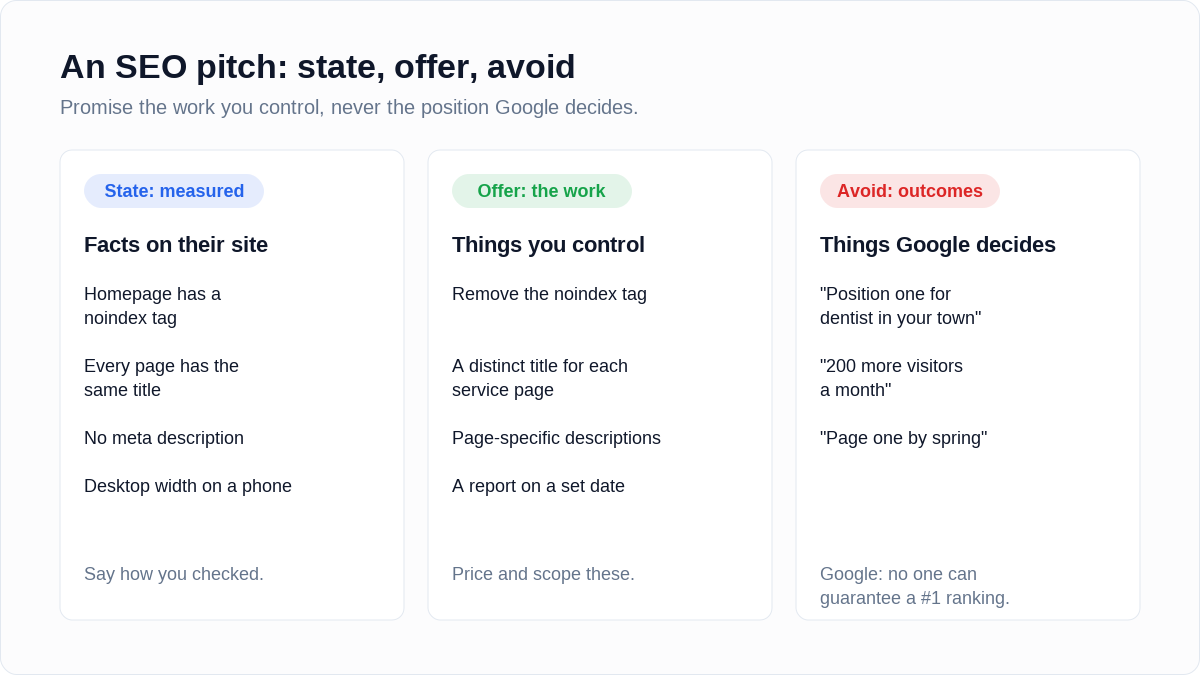
What you can promise is the work: the faults you will fix, the pages you will write, the report you will send and when. Once a prospect signs, a platform built for delivery, with rank tracking and listings management, does the reporting that prospecting tools do not. The comparison with BrightLocal sets out where each kind of tool fits; as of November 2026 BrightLocal's pricing page starts at $41 a month for one location on its Track plan, with a 14-day trial.
What should the first paid engagement be?
Make the first engagement a fixed-scope project built from the audit, then offer monthly work once the owner has seen you deliver. A small, defined job is easier to say yes to than an open-ended retainer from someone they met last week.
- Scope it from the findings. Each fault in the report becomes a line item: remove the noindex tag, write a title and description for each service page, add a viewport tag, fix the contact form.
- Make every item testable. Run the same audit at handover and send the before and after. The owner can see the work was done without taking your word for it.
- Set up measurement first. Get Search Console access and note clicks and impressions for the months before you start, so any later case study compares like with like.
- Then propose the ongoing work. Content for missing service pages, review requests, listing upkeep and monthly reporting are the parts that take time to show results, which is why they suit a retainer.
Price is yours to set and depends on your market, so this guide gives no figures. The before and after from this first project is also your next case study, which feeds the first channel in this guide.
Ready to find your first leads?
Start with 50 free leads every month. No credit card needed.
Frequently Asked Questions
Sources
- Google Search Central: Do you need an SEO?
- Google Search Central: Influencing your title links in search results
- Google Search Central: Control your snippets in search results
- Chrome for Developers: Page is blocked from indexing (Lighthouse audit)
- Chrome for Developers: Document doesn't have a meta description (Lighthouse audit)
- Search Console Help: Performance report (Search results)
- Google Search Central: Understanding page experience in Google Search results
- Google Search Central: Mobile site and mobile-first indexing best practices