SEO leads: find local businesses that need SEO help
A good SEO prospect has problems you can measure and fix. CazaLead pulls a niche and a city from Google Maps, audits every website and shows which businesses have them.
Start with 50 free leads every month. No credit card needed.
What makes a local business a good SEO lead?
A local business is a good SEO lead when its website or Google listing has a problem you can measure, explain in one sentence and fix.
This page is for SEO consultants, marketing agencies and web design studios that sell to local businesses. Our guides to finding local SEO clients on Google Maps and finding clients for a marketing agency cover the wider method.
How do you find SEO leads with CazaLead?
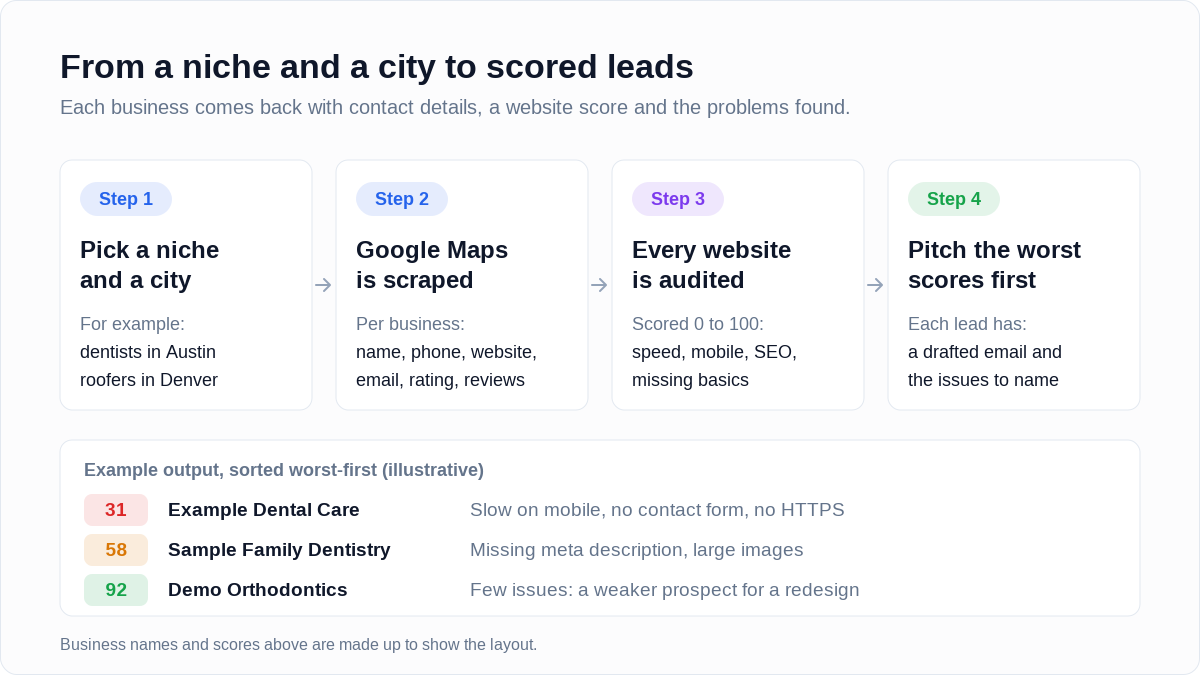
You find SEO leads with CazaLead in four steps: pick a niche and a city, let it audit every website, filter the list, then pitch from the findings.
- 1
Pick a niche and a city
Choose a business type you know how to rank, such as dentists, and one location. CazaLead, a no-code web app, scrapes the matching businesses from Google Maps.
- 2
Let every website be audited
Each site is run through Google Lighthouse in a real Chromium browser, plus checks such as HTTPS, mobile viewport, page weight and schema markup. Auditing does not use up lead credits.
- 3
Filter the list
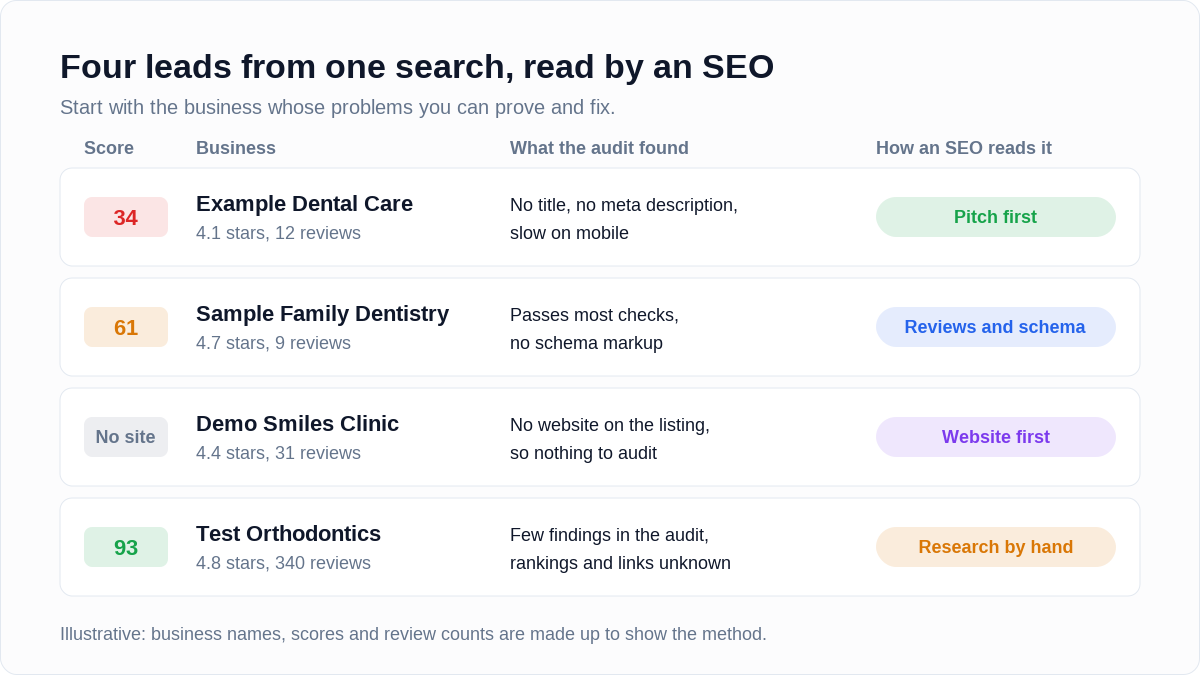
Narrow it by Google rating, review count, review recency or businesses with no website, then start with the lowest website scores.
- 4
Read the findings and pitch
Open a lead and read its Lighthouse SEO and performance results and the problems listed. Each lead comes with a drafted outreach email that names them (AI-written on paid plans): check it against the audit and send it yourself.
What do you get for each business?
For each business you get the Google Maps listing details, an email address where one is published, a website score from 0 to 100 and the problems the audit found.
| What comes back | What it tells an SEO |
|---|---|
| Name, address, phone, website and category | From the Google Maps listing. |
| Google rating and review count | How the listing compares with others in the same search. |
| Email address | From the business's own website where one is published, with an optional validation check. |
| Website score, 0 to 100 | Low scores have the most to fix. |
| Problems found | The findings you quote in the pitch. |
| Outreach email draft | Drafted from those problems on every plan, AI-written on paid plans. |
| PDF audit report | Your logo and colours on paid plans, CazaLead branding on the free plan. |
Lists export to CSV, and the source is Google Maps. See white-label audit reports for how to use the PDF.
Which audit findings point to SEO work you can sell?
Six findings point most directly to SEO work: a low Lighthouse SEO score, a missing title, a missing meta description, no schema markup, a slow or non-mobile page and few Google reviews. Quotations are from Google's documentation as of November 2026.
| Finding | Why it matters for search | Service you could sell |
|---|---|---|
| Low Lighthouse SEO score | Lighthouse's SEO category checks basics: the page can be indexed and has a title, a meta description and descriptive link text (Lighthouse source code). | On-page and technical clean-up |
| Missing or generic title | Google builds its title link from the title element, among other sources, and calls it "often the primary piece of information people use to decide which result to click" (Google Search Central). | Titles rewritten for each service page |
| Missing meta description | Google sometimes uses the meta description as the snippet and says good ones "can go a long way to improving the quality and quantity of your search traffic" (Google Search Central). | Descriptions written page by page |
| No schema markup | Google "uses structured data that it finds on the web to understand the content of the page" (Google Search Central). LocalBusiness markup can state opening hours; Google does not promise a changed result. | LocalBusiness schema set-up |
| Slow mobile page or no mobile viewport | Google indexes and ranks the mobile version of a site (mobile-first indexing) and says "Core Web Vitals are used by our ranking systems" (page experience). | Speed work, or a responsive rebuild |
| Few Google reviewsFrom the Maps listing, not the website audit | Google says "More reviews and positive ratings can help your business's local ranking" (Google Business Profile Help). | Review requests and profile management |
How do you get SEO clients with an audit?
You get SEO clients with an audit by showing the prospect one or two findings from their own site, saying what each means for a customer who is searching, and proposing one small next step.
Keep every claim checkable, for example: "Your homepage has no meta description, so Google picks the text under your listing itself." Do not promise positions. Google's SEO Starter Guide says "There are no secrets here that'll automatically rank your site first in Google". For wording on speed, see Core Web Vitals for non-technical agencies.
What does the audit not measure?
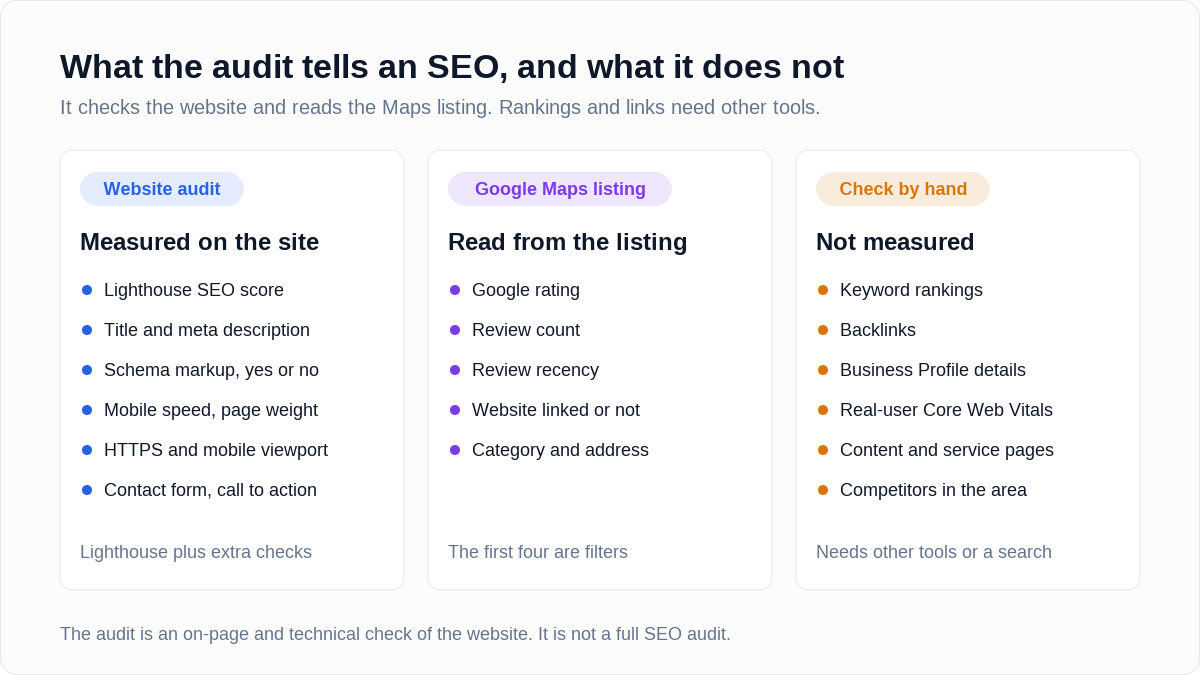
The audit does not measure rankings, keyword positions, backlinks or how complete a Google Business Profile is. It is an on-page and technical check of the business's website, plus the rating and review count from the listing.
Lighthouse says of its own SEO checks: "There are many additional factors Lighthouse does not score here that may affect your search ranking" (Lighthouse source code). So a high SEO score is not proof that a site ranks, while a low one is proof of basic gaps. Check three things by hand before you quote:
- Rankings. Search the main service and city terms yourself, or use a rank tracker.
- Backlinks. Google "uses links as a signal when determining the relevancy of pages" (Google Search Central); seeing them takes a link tool.
- The Business Profile. Google says "Businesses with complete and accurate info are more likely to show up in local search results" (Google Business Profile Help), so check categories, hours and services.
When is another approach the better choice?
Another approach is better when you need rank tracking, citation work or prospects that are not on Google Maps. BrightLocal's site lists a Local Rank Tracker, a Citation Tracker and a Citation Builder as of November 2026: see CazaLead vs BrightLocal.
Because the source is Google Maps, CazaLead is the wrong tool for businesses with no local listing, such as online shops. For one or two prospects, the free website audit tool checks a single URL. A business with no site needs one before SEO: see web design leads.
How much does CazaLead cost?
CazaLead costs from $0 to $149/month as of November 2026, and every plan includes the website audit on every lead.
| Plan | Price | Leads a month |
|---|---|---|
| Free | $0 | 50 |
| Starter | $9/month | 1,000 |
| Pro | $59/month | 10,000 |
| Business | $149/month | 100,000 |
Paid plans add AI-written outreach emails, white-label PDF reports, advanced filters and priority support. Details are on the pricing page.
SEO leads: common questions
Find SEO leads with the evidence attached
See which businesses in your niche have SEO problems you can name.
Start with 50 free leads every month. No credit card needed.