How to Get Web Design Clients: A Plan for Freelancers (2026)
How a freelance web designer or small studio gets clients: referrals, a niche portfolio, local outbound to weak websites, partners and marketplace fees.
Getting web design clients as a freelancer or a two-person studio comes down to a few channels, each with a different cost in time and money. This guide covers them honestly, explains why nobody can tell you how long a first client takes, and spends most of its length on the one channel you can start today without an audience: local outbound to businesses whose websites have a problem you can measure.
Which channels bring web design clients?
Five channels bring web design clients: referrals and past clients, a portfolio aimed at one niche, local outbound, partnerships with businesses that serve the same customers, and freelance marketplaces. They differ in what they need from you before they produce a single conversation.
| Channel | What it needs from you | Who controls the pace | Main cost |
|---|---|---|---|
| Referrals and past clients | Finished projects and people who liked the result | Your clients | Time to keep in touch |
| Niche portfolio | Two or three projects in one trade, written up | Search engines and the people who find it | Time to build and write |
| Local outbound | A list, an audit of each site, a short message | You | Time per prospect |
| Partnerships | A partner who meets your buyers first | The partner | A referral fee or a return favour |
| Marketplaces | A profile and proposals | The marketplace and its buyers | A fee on every payment |
For a wider view of these channels across agency types, see how a marketing agency finds clients. The rest of this guide stays with web design.
How long until a first client conversation?
Nobody can give you a reliable number, so treat any figure you read as a guess. What you can reason about is what each channel waits on.
- Referrals wait on a past client meeting someone who needs a site. With no past clients, this channel cannot start yet.
- A portfolio waits on being found. A new site with a handful of case studies has no search history, so expect a slow start and judge it over months, not weeks.
- Marketplaces wait on a buyer picking your proposal over others, which is hard with no reviews on the platform.
- Outbound waits only on you: how many owners you contact and how specific your first line is. That is why it suits someone with time and no audience.
The practical plan for a new freelancer is to run outbound every week while the slower channels build up behind it, and to turn every finished project into a case study and a referral request.
How do you get more from referrals and a niche portfolio?
Ask for a referral at the moment a client is happiest, usually just after launch, and make it easy: one sentence they can forward, describing the kind of business you help. Then contact past clients a few months later with something useful, such as a check of their site's speed, which often turns into small paid work or a name.
A niche portfolio works because an owner looks for work like theirs. Three sites for physiotherapy clinics persuade a physiotherapist more than ten sites in ten trades. Write each project up as a case study: the problem, what you changed, and a before and after you measured, such as the mobile PageSpeed result or whether the site had a working booking form. Avoid claims you cannot show, such as "doubled their enquiries", unless the client gave you the figures and agreed you can publish them.
How do you pick a trade and a town for outbound?
Pick a trade where customers look a business up before they call, and a town where that trade has enough businesses to fill a list. One trade in one town keeps your research, examples and messages consistent.
- The website matters to the sale. People research a dentist, a roofer or a wedding photographer before they get in touch. A site that fails on a phone loses those visitors.
- There are enough of them. Search the trade and town on Google Maps. If the list runs out after a dozen businesses, widen the area.
- You can speak their language. A trade you have worked for, or a town you know, gives you details a generic pitch lacks.
- They can pay. A sole trader with a van may want a one-page site; a practice with several staff can fund more.
For a comparison of trades by these factors, see niches for local lead generation. Businesses that turn up with no website at all go on a separate list, because the pitch is for a first site: see businesses without websites.
How do you tell a weak website from a fine one in two minutes?
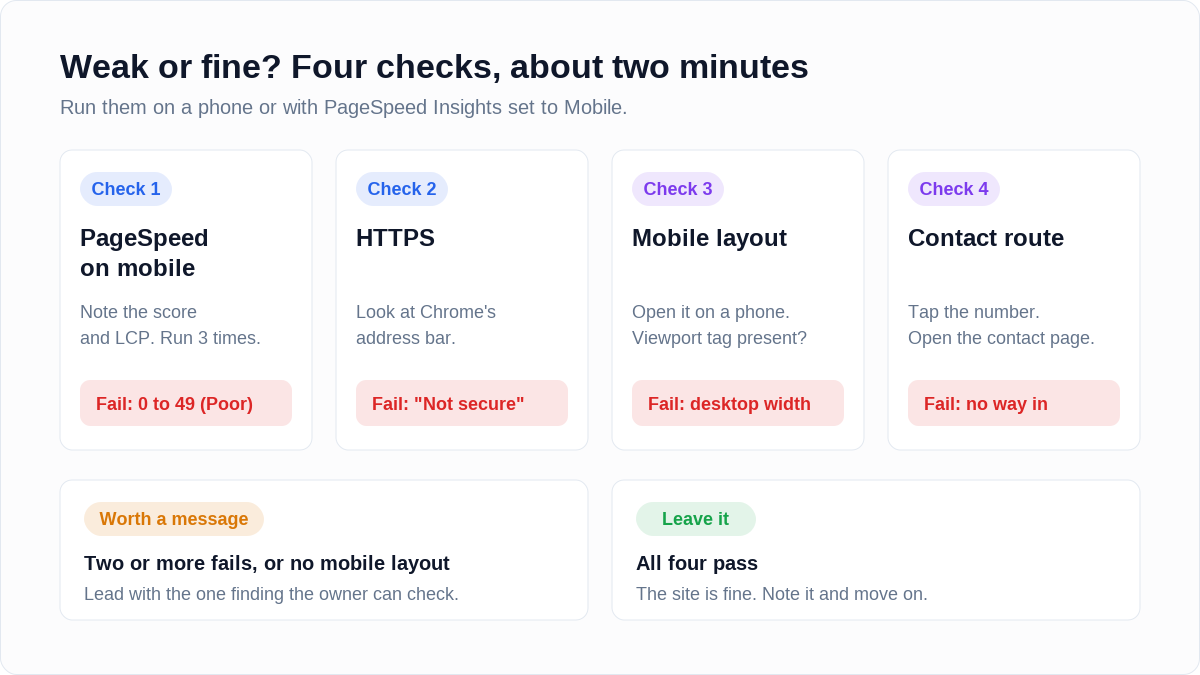
Run four checks: a mobile PageSpeed Insights test, HTTPS, a mobile layout, and a working way to get in touch. Two failures, or a missing mobile layout on its own, make a prospect worth a message. A site that passes all four is fine; note it and move on.
- 1PageSpeed Insights, mobile tab. Paste the homepage into pagespeed.web.dev. Google's PageSpeed Insights documentation says a score of 90 or above is good, 50 to 89 needs improvement and below 50 is poor, and that the lab test emulates a mid-tier phone on a mobile network. Note the score and Largest Contentful Paint. For a small business, the real-user section at the top is often empty, because the documentation says it shows nothing when a site has too little Chrome traffic.
- 2HTTPS. Look at Chrome's address bar. If it says "Not secure", Chrome's help page explains that the site doesn't use a private connection, and that someone might be able to see information sent through it.
- 3Mobile layout. Open the site on a phone. Chrome's Lighthouse viewport documentation says that without a viewport meta tag, phones render the page at desktop width and scale it down. In the PageSpeed report this appears as "Optimize viewport for mobile". It matters for search too: Google's mobile-first indexing page says Google uses the mobile version of a site's content for indexing and ranking.
- 4A working contact route. On the phone, find the number and tap it: it should offer to call. Open the contact page and check the form loads, or that an email address is shown. A broken form or a number inside an image is a finding an owner will understand at once.
Run the PageSpeed test twice more before you quote it, because lab scores move between runs. By hand, these checks take a few minutes per site, so a town of a hundred businesses is a few evenings of work. CazaLead does the listing and checking in one pass: it collects a trade and town from Google Maps, runs Lighthouse and its own checks (HTTPS, viewport, load time, contact form and others) on each site, gives each a 0 to 100 website score and lists the problems found. It reads Google Maps only, exports CSV, and its free plan covers 50 leads a month. The web design leads page shows that workflow, and the free website audit tool checks a single address.
What should your first message say?
Your first message should name one problem you measured, say how you measured it, say what it means for a customer, and ask one small question. One clear finding is easier to check than a list of ten.
An example with made-up details: "Hi Sam, I opened greenleafphysio.example on my phone this morning. The page loads at desktop width, so the booking button is too small to tap without zooming. I build sites for physiotherapy clinics in Leeds. Would a short write-up of what I found be useful?"
- Pick the finding the owner can verify. A layout problem on a phone beats a performance score they have never heard of.
- Describe a lab result as a lab result. Write "in a test on a simulated phone", not "your customers wait six seconds".
- Do not invent losses. You do not know how many enquiries the site loses, so do not put a number on it.
- Follow the email rules. The FTC's CAN-SPAM guide requires honest headers and subject lines, a valid postal address and a way to opt out, honoured within 10 business days, and says the law makes no exception for business-to-business email. This is not legal advice.
When an owner replies, the next question is whether the site needs a rebuild or a repair. That decision, and how to scope each, is covered in how to find clients who need a website redesign: in short, faults in the template or platform point to a redesign, while slow images, missing HTTPS or absent titles are usually repairs, and pitching a rebuild for a repair costs you trust.
Are partnerships and marketplaces worth it?
Partnerships are worth setting up once you have work to show, and marketplaces are worth it if you price the platform's fee into every quote. Neither replaces a channel you control.
Good partners meet your buyers before you do: accountants, sign makers, print shops, photographers, business coaches and SEO consultants who do not build sites. Offer something concrete in return, such as sending them your clients who need their service, or a referral fee agreed in writing.
Marketplaces bring buyers who are already looking, at a price. As of November 2026, Freelancer.com's fees page says the fee for fixed-price projects is 10% or $5.00 USD, whichever is greater, and 10% for hourly projects. Contra's pricing page says it is commission-free for creatives and lists a Pro plan at $29 a month or $199 a year. Upwork and Fiverr set their own seller fees and publish them in their help centres; read the current figure there before you quote, because the fee comes out of your price.
Keep one channel you own. A marketplace profile and a partner's goodwill can change without notice. A list of local businesses you have audited, and the case studies from the ones who said yes, stay yours.
Ready to find your first leads?
Start with 50 free leads every month. No credit card needed.
Frequently Asked Questions
Sources
- Google for Developers: About PageSpeed Insights
- Google Chrome Help: Check if a site's connection is secure
- Chrome for Developers: Lighthouse audit: viewport meta tag with width or initial-scale
- Google Search Central: Mobile site and mobile-first indexing best practices
- Federal Trade Commission: CAN-SPAM Act: A Compliance Guide for Business
- Freelancer.com: Fees and Charges
- Contra: Pricing